London Viola Player, Fiddle Player & Arranger

In which size may or may not matter

And I may or may not make inconsistent attempts to punningly link disparate observations from a day’s playing back to an eye-catching headline.

On Sunday, I was swelling the ranks of St Giles Orchestra’s violas again – and if anything with rather more need than last time, since we were four in total. That might have balanced about right with the two double basses, but was underpowered to the five cellos let alone the serried ranks of violins I didn’t try to count, and is definitely on the low end for balancing the wind and brass scoring of Bizet (first Carmen suite) and Dvorak (fourth symphony).

The event was not a conventional concert though. It was a conducting masterclass – so primarily a training event for young aspiring conductors. Of course, one can only do a quite limited amount of training conductors without an actual orchestra for them to conduct, and so we were acting as, perhaps, the clay on the wheels of these trainee potters (adjust metaphor to taste). Perhaps unsurprisingly, it also had a competitive element, to which I shall return later. I’m unsure that education and competition are as good bedfellows as some contemporary praxis might suggest, particularly (as in this instance) where the participants are at wide-ranging levels of experience and commitment to the craft. An emphasis on a winner in (almost inevitably) terms of level of ability demonstrated draws attention away from progression, perhaps the only metric that could fairly be applied across the board here. Further, if someone has ‘won’, can they therefore stop learning? If someone has ‘lost’, do they see the day as a failure rather than assessing what they learnt and how much better they got? There is incidentally a subtle difference here between assessing for a qualification – which is, at least in principle, an objective, transferable, constant level of skill which can be used to indicate whether one is equipped for such and such an opportunity, essentially – and judging a winner from a field – which indicates the best of those present without any necessary objective benchmark, and so is or should be a much less used indicator of ability thereafter.

In any case. Four teenagers got to use movements of the Carmen suite as test beds for relatively (in at least one instance totally) novice efforts in conducting. Some showed genuine expression; some had at least a very clear and followable beat; one I am sorry to say looked a little like he had changed his mind about wanting to be there, but I’m no mind-reader. The others certainly had intent and progressed markedly in their bare half-hour’s coaching and a performance of their movement at the end of the day. From the orchestra’s point of view, the material provided about the right level of musical challenge to work with these inexperienced conductors – the individual parts are sometimes difficult (solo woodwinds mostly, particularly the oboe – St Giles are very fortunate in their principal oboist, Matthias Winkler) but the ensemble fit has only occasional corners where the performance will really stand or fall on the conductor’s work, though of course good conducting can make it much better.

Particularly in this first half, where more time was spent on coaching and less was needed on running through the movements, I found it fascinating to watch Peter Stark, the ‘master’ of the masterclass if you will, at work as a teacher. (He is also an excellent conductor, but I spend a lot more time with conductors than tutors, particularly of conducting!) Conducting, perhaps like teaching, is a craft and role I am more inclined to avoid than pursue, but for any musician who is going to be conducted on a regular basis it cannot be other than helpful to know more about it. How one goes about teaching is of course widely varying and individual, and depends on the context and the subject matter and so on and so forth. One consequence of this situation was that Stark was simultaneously giving individual pointers to the conductor currently having their half-hour – and also projecting general summaries of this to the rest of the group of eight, who were sat at the back of the stage throughout. It says something for his ability as a teacher that I cannot recall him having to make the same point to two different people.

Teaching an individual, as this mostly is, of course allows a closer engagement with their individual response. One can take hold of the wrist or elbow and guide the shape of a beat; converse directly if briefly; and so on. And of course what one does next is targeted to the weaknesses, and the strengths, of the pupil. But there are some other things that struck me.

One is that above a certain level, the role of physicality seems to be re-accepted into art music training (this does not only apply to the conducting workshop under discussion). Whereas it is almost all about sound, with a perhaps rarefied reverence for the purity of musical art, in a certain middle territory, if one advances to the level perhaps of those who train future or would-be professionals then the embodiedness of musicians comes back into the picture. Of course, conductors do not actually make any noise; while actually conducting, their role is essentially entirely gestural (hands; body language; facial expression; but all gesture) and this leads to a more physical understanding of technique; perhaps. But a conscious division of labour between baton, face and body; instructions on handling tempo by using more or less length of the arm; literally standing with one’s hand outstretched to be struck from underneath in order to make a double point about all beats being ultimately upwards (interesting! ban the word ‘downbeat’ – quite a drastic suggestion for orchestral circles) and about a moment of much greater acceleration at the point of the beat itself – this to me correlates rather closely with my current viola teacher’s insistence that posture and body language are not merely a question of avoiding damping the instrument’s vibrations, or of avoiding later life back trouble, but can actually create the impression of more volume than the instrument will in fact project, and that looking confident and performative will improve the sound beyond what is explicable in simple acoustic terms. (I have had to start wearing shoes I can stand on tiptoe in to my viola lessons, for purposes of fortissimi!)

Returning to chronology. Three university students and one decidedly precocious sixth-former each had a movement to handle of Dvorak’s fourth symphony. Whether the division into two groups was entirely fair to the distribution of conducting abilities I’m not sure – I think it probably was; but certainly this was a massive step-change in demands.

I have never otherwise played or heard in concert any of Dvorak’s symphonies except the last two, the eighth and ninth. He famously disowned the first four, hence why some old copies label the ‘New World’ as his fifth, confusing the issue. However, the earlier symphonies are very rarely performed. Having played the fourth, I perhaps have a glimpse of insight into this. It is not significantly less ambitious than the later symphonies – purely on grounds of length, the first two movements clock in over ten minutes long each (this will indicate the difficulty of coaching conductors having only half an hour to work on each movement!), and the architectural desire of a grand scale, if that phrase makes any sense, is similar. It could be argued that the last two symphonies are slightly more successful – more varied, perhaps, in their final output, where there can be a sense of overkill to some of the fourth. But I would not want to overstate this – few composers have written post-Beethovian, grand-scale symphonies as successful in their goals as this one is in its pursuit of musical expression of Burke’s sublime (a minor key symphony from the mid-nineteenth century is almost always seeking after the terrible, more than the beautiful) as early as opus 13. My suggestion is simply that the earlier Dvorak symphonies are rarely heard because their musical goals are too similar to the later, very slightly more accomplished, ones. The symphonies of Beethoven, to take an obvious contrast, set out to do wildly varying things in widely varying ways; the only ones that are felt to end up overlapping or in competition with each other are numbers 1, 2, 4 and 8,  and even this might be held to be a misprision or oversimplification.

In any case, returning to conducting. This presented much more real musical (and, for most players, playing-of-notes) challenges to both conductors and orchestra than the Bizet. At an obvious level there are tempo changes indicated and implied, pauses to be negotiated, balance of parts to be kept when there is more to it than tune and accompaniment. There is also the question of how to create variety and structure within a movement that may last 11 minutes and have a couple of dozen ff markings; and of creating, where appropriate (arguably for most of the three fast movements), that now rather unfashionable projection and indeed adulation of intense negative emotion that goes with Romantic art.

Much less of the tuition was about straightforward directing technique at this level of course. Ironically one moves largely from how to conjure forth something from players – to the question of what should really be requested, and how one makes aesthetic decisions of that nature.

Minefields abound in discussions in which the terms of reference may include the creative arts, gender, and different kinds of emotion. But at some point I have to bring up, if only in token protest, a significant point about this workshop, which is that the young woman who conducted the first movement of the Dvorak was the only female participant out of eight. Sadly, this is still all too indicative of the situation in conducting, particularly orchestral conducting, in general (I probably play under woman conductors less than one-eighth of the time in fact); something which I have commented and speculated on at length in another post and so will not return to here.

Nonetheless, it cannot but be ground of speculation to wonder what difference it would make if around half of conductors (not necessarily at top-flight professional level either) were women – whether, factoring in cultural gender specifics in the postmodern West, this would lead to a change in the as it were sign language used between conductors and players (the orchestral players are increasingly well gender balanced, with some specific instruments exceptional but not as badly so as rock instrumentalists), or even to some aspects of the music sound. It is all too familiar, perhaps, that in this instance the key piece of feedback from Peter to Gabrielle was to engage more vigorously with the intensity and the negativity of some aspects of the movement – more grit, as it were. And with any sense of the cultural history of post-Enlightenment Europe, one cannot do otherwise and successfully render Dvorak (nor, let me hasten to add, such female composers as Clara Schumann or Amy Beach – the women creators of the time certainly did not allow the men monopoly over the ‘sublime’, whatever some male theorists may have sought to command). However, I would wish to record that, to me, the single most noticeable instance of a change in conducting technique over the day was the extra call to intensity in the performance of this movement compared to the rehearsal – it could certainly have gone further, but the change was striking even having heard it being requested.

One last aspect of this day’s playing has little to do with conducting, though something to do with the moody power demanded of his orchestra by Dvorak, and is responsible for the title (apart from all sorts of dreadful low-Freudian implications about batons and female conductors). I came back from a break towards the end of the day, having left my viola on my chair, to find my section leader holding it up against hers. It took me a moment to realise what she was doing, but it may take a little longer to explain for anyone reading this who is not very familiar with the viola.

The violin and the cello are more or less ideally constructed, in terms of projection, for their pitch and playing with a bow. In other words, I am assured that a bigger-bodied violin, or a cello with a longer scale length, would not actually be heard more clearly. The viola as we normally know it is not constructed in the same ratio to its range; it is essentially undersized. It is possible to create violas in the same proportions, but they are too long to reach the end of the neck with the instrument under the chin, and the notes are too far apart to play with the conventional two semitones to a finger of viola technique. Those who play them (including one player with St Giles, whose extra power was significantly missed on Sunday) hold them upright, on a long cello spike, on top of or between the knees, and use something more like a cello fingering pattern, with many more changes of hand position. The result is certainly louder, but arguably does not sound quite like a viola – the different set of correspondences leading to a normal behaviour that is part of listeners’, and indeed players’ and composers’, expectations (compare the degree to which an electric guitar amp is expected to distort the input signal because ‘that’s what electric guitar sounds like’).

In any case, the conventional viola exists in a land of compromises, in which there is a tacit agreement that a bigger body would be desirable (no sniggering at the back there), but the main constraint is what an individual player can actually comfortably perform on. While there are variations in the ratio of body width to body length, and probably lesser ones in neck length to back length, the standard metric for comparing violas is the back length (excluding neck) in inches, in practice to the nearest half an inch. The standard range appears to 15 to 16.5 (giving a choice of four sizes), though I am sure I have come across as small as 14.5 and as large as 17. (For comparison, the ‘correctly proportioned’ instrument mentioned above has a back length of 20.5″.) Unsurprisingly, there grows up a perception that large violas are straightforwardly more powerful and gritty, and smaller ones both quieter and of a more soft and muted sound. Equally unsurprisingly to anyone who has any experience dealing with stringed instruments, there is in fact a great deal more to it than that and the length principle may be much less important than other factors of construction – there is after all huge variation in the volume and sound of violins, some of which can be changed on the same violin by altering apparent minor factors of setup (I posted about this recently), and all of which take place within instruments that are an almost exactly standard size.

What Judith was doing, then, was using her viola as a measuring-stick to get a sense of the back length of mine; almost certainly, from the way in which she commented on the result, to see if it was on the larger end, having been able to hear me projecting significantly during louder passages. (There were only four violas, remember, so her left ear was probably only four feet from my soundholes, and there were not that many sound sources to disentangle.) For the record, my viola appears on application of a tape measure to have a back length of 16″; so large, but not the top end of the normal range. I would suggest it does punch above its weight for this sort of context – it is probably a ‘better’ instrument than many being played in amateur orchestras, and certainly inclines to the loud and gritty – which is of course not always a good thing; it requires extra work to produce a really effective singing piano on it. However, I would go further and suggest that, again in the context of an amateur orchestra viola section, the extra power that had caught Judith’s ear (herself I am told an ex-pro, by the way) is as much to do with the technique being brought to bear by training at diploma level with a teacher who only recently left a conservatoire Master’s degree programme, as it is to do with the instrument itself. Perhaps, to resume awkward cliché where the title left off, size matters less than what you do with it.

This has become a long and rather dense read on a long and decidedly hard work day – but the day was at least fulfilling and interesting. Expect shorter write-ups of small-forces Bach in Chichester and Mendelssohn oratorio in Lincolnshire this coming weekend, and of choral and orchestral music in the Channel Islands the weekend after (though the travails of organising transport to and from that event might warrant a post to themselves). And keep your eyes peeled to a return to rock band gigging after what feels like a very long pause!

The long haul

Partly because getting hired for two consecutive concerts in the same negotiation is being in for the long haul if you’re a working musician bumping amateur orchestra sections. So I’ll be back with the St Giles Orchestra next weekend, though for a more unusual event.

Also because last night’s concert, while in many ways excellent, was definitely an endurance event not a sprint! – perhaps particularly so for the strings. The programme went as follows:
Wagner: Entrance of the Gods into Valhalla, from Das Rheingold
Bizet: Suites 1 and 2 from Carmen (some movements done as the original soprano arias rather than instrumental transcriptions)
Shostakovich: Suite for Variety Orchestra (the work that used to be wrongly known as Jazz Suite no. 2)
Wagner: Brunnhilde’s Immolation and Finale, from Gotterdammerung
(I apologise for my unwillingness to input umlauts to a web text interface on Sunday afternoons)

I hadn’t really processed in advance that the first Wagner excerpt there is the length of a decent overture, and the second is a good solid 20 minutes. (For the uninitiated, whatever your aesthetic opinion of Wagner, his music is almost always unremitting hard work for the string players, who are sustaining the core texture of that monumental sound almost throughout, whether it is as quite as possible or deafeningly intense – and of course the tendency is to shift from one to the other rapidly most of the time) The second Carmen suite is rarely performed, and the two together take you up to something like a dozen sections, though they are all quite short.

The same could be said of the Shostakovich, with its dance-styled movements (more respectable early 20th century, waltzes and polkas, than the jazz with which it has been mistakenly associated (chiefly a case of mistaken manuscript identity!)) tending to come to between two and six minutes – but there are eight of them. The strings swap between oom-pah accompaniment (on occasionally startling chords, though less so than most Shostakovich ersatz dance music), quite lyrical melodies and running countermelody figures. Unfortunately, for reasons which the violas swapped educated guesses about in the breaks, the violas almost always double the second violins. At the same octave. Cue much reading of treble clef ledger lines, muttered swearing and myself occasionally either wishing I’d brought my violin along or forgetting which instrument I was holding. An interesting consequence of playing music which is still in copyright and therefore can’t be found in sheet form on the internet, and of paid bumpers never usually doing more than the final rehearsal and the concert (of course, all professionals are so much better than all amateurs that we raise the standard automatically on about as much rehearsal time as performance. No, this is not my poker face. No, I am not rather mediocre at poker, how dare you.). Suffice to say I was glad of a long break between rehearsal and concert, about half of which became practice time so that I could follow the high runs properly on the second time through, better known as the performance … right note reached about three times more often.

Whatever tribulations of some of the players though, we had a packed house (I think having a balcony in the venue easily compensates for the space taken up by a Wagnerian orchestra … ) and an appropriately monumental sound. Credit also to soprano Mary Pope – you can usually judge quite accurately whether a singer is handling Romantic grand opera by how clearly you can hear them from the orchestral string section, which is of course behind the singer. Very clearly in this instance!

As mentioned above, I will be back with this group next weekend – Sunday 7 May, to be precise, for a conducting masterclass at Radley College. Apparently the whole thing is open to the public if you really enjoy watching the musical process in action! For the rest of us, Dvorak’s rarely-heard fourth symphony and the much more often heard first Carmen suite will be performed between 5 and 6pm, followed by adjudication and results. After which I can start preparing for the two orchestral concerts I’m doing the weekend after that (with different ensembles).

Like I said, I’m in this for the long haul.

Homecoming gigs

Well, maybe. Defining ‘home’ is a discussion for another day.

When I lived in Oxford, I played hardly any paying gigs there. In fact one of the reasons moving to London was practical as well as romantic was to be closer to most of my music work, with the amount of time I was spending travelling to or through the capital.

Of course, now that I’ve moved away I have a string of concerts in and around Oxford this summer. So for those who said they’d come when I was playing something local, I intend to hold you to it! and here are the relevant details:

Saturday 29 April

(yes, this Saturday!) St Andrew’s Linton Road OX2 6UG, 7:30: St Giles Orchestra, playing Wagner, Bizet and Shostakovich. See orchestra website here.

Sunday 7 May

Silk Hall, Radley College OX14 2HR, 5pm (note time): St Giles Orchestra, closing concert of a conducting masterclass, with the first suite from Carmen and Dvorak’s 4th symphony. Website here.

Saturday 15 July

Challow Park Studios, Wantage OX12 9RH, 7:30: The Challow Chamber Players and Sarah Barnett, performing Britten’s Les Illuminations and Tippett’s Concerto for Double String Orchestra.

Friday 4 August

The Filthy Spectacula open the evening entertainment on this night of Oddballs Rally, Abingdon Rugby Club OX14 5TJ.

See you there Oxonians!

On the wireless

From an otherwise difficult busking session in Waterloo station a little while back (it’s being extended and there was a lot of building site noise!), please welcome my first national radio appearance (that I can think of – any counter-bids, do let me know!) – starting and underscoring this BBC Radio 4 feature:

http://www.bbc.co.uk/programmes/b08md9xf

Admittedly it is partly a worked example of what you actually have to do to abide by copyright law – including gaining permission from a busker playing traditional, out of copyright material in public in order to use a recording of that playing on a radio programme. But still me credited by name on Radio 4, you know? And no, we didn’t script, rehearse or re-record that opening exchange, and yes, we were having it while I was still playing (it isn’t an overdub) – I tend to avoid interrupting a number to talk to someone unless it’s clearly going to have to be an extended exchange; at least fiddle is relatively easy to play while talking!

Credit to fellow Merseyside musician and sometime busker Gaz Gaskell for hearing my name in the programme and managing to track my website down in order to give me a heads-up about it! Play on …

Crafting sounds

As I was packing away my violin after the last performance on Friday, a chunk of the bridge snapped off, leaving the Fishman bridge unattached (I have a suspicion I’d made a bad job of attaching the pickup a few days earlier, but that question isn’t important to this story). This left me in real difficulties: I needed to play five sets over the following two days, some acoustic, some amplified, in order to fulfill a very well paid job; my only other violin (the Harley Benton electric) can only be played amplified and at best this could only be played acoustically now, even if the bridge hadn’t been damaged in some such a way that it would give way altogether shortly; and it was already early afternoon on a bank holiday. I needed a spot of luck.

After some googling, and some unanswered phone calls, enter Ruschil & Bailly, of whom this post is largely an appreciation. Now business names of the form Surname & Surname are extremely common in Britain (especially lawyers, estate agents … ); what is more unusual about this one is that the names are actually those of the two leading players, Antoni Ruschil (who works on violins) and Florian Bailly (who does bows). And while I often refer to myself (as musician) as a craftsperson to avoid the awkward post-Romantic cultural baggage of the label ‘artist’, these two (and their apprentice, who I sadly haven’t met) fit the label in a much more obvious sense, working very individually and very hands-on with organic materials out of a single-room workshop about the size of my living room (well – our living room; I share it with three other people and two cats).

First point of recommendation: despite being a bank holiday weekend, they took in my injured violin a couple of hours after I got in touch, and had it fitted up with a replacement bridge which was both a better shape (for more even string height, or ‘action’) and better quality than the original, with the Fishman fitted, in time for me to pick it up in the morning and play the next set at 11. The acoustic sound ‘felt’ better under my chin than before, and I’m assured the amplified sound was better from out front than the day before, too. What’s more, they had found time to give the violin the first proper clean of its life, polishing off the accumulated rosin-reacted-with-varnish and heaven knows what other grime of 15 years or so mostly being played pretty hard and carted around with less care and protection than might have been ideal.

A minor interjection here, for a more personal and less professional perspective: like a lot of luthiers, violin makers and repairers, and so on, who tend to deal almost exclusively with classical (in the broadest sense) players and their equipment, amplification is not home turf to these gentlemen. But I mention that only to say that their response to my turning up with a pickup partially attached, requesting that the business end be clamped into the new bridge (that being how the Fishman works), was not reluctance, rejection or refusal but a genuine curiosity about the device, and willingness to deal with it – and, as mentioned above, a very good end result. Similarly, over my three visits (see below) we had some extended conversations about the range of playing I do; not part of a marketing strategy, simply genuine enthusiasm for and interest in the field in all its permutations. I hope you can both make it to one of my gigs some time, guys. Just bring earplugs, just in case!

My second main point of gratitude is that, as a free spinoff from having had the replacement bridge, I was able to come back at a point when I was less busy (which happened to be this morning) and spend some time on sound adjustments.

Now the subtleties of what, in construction and in setup, affects the tone and response of an acoustic violin or its cousins is beyond my full grasp, as it is that of most players. It might suffice to say ‘everything’; among what I have heard mentioned in my visits to Ruschil & Bailly are the ratio of body length to neck length, the wood (of basically every bit of the instrument – body, bridge, soundpost … ), the density of the grain (related to how quickly the tree was growing at the time) at different places, the hardness of the varnish, how parallel the soundholes are to the sides, the length of string behind the bridge (varied by lengthening the little length of gut that holds the tailpiece in place), and the position both left-to-right and front-to-back of the soundpost. I’m sure this is not a comprehensive list!

Obviously, many of these are intrinsic or more or less so to the instrument; a few are not, and in practice this morning was spent entirely shifting the soundpost. For the uninitiated, this all-important component looks like nothing more than a short length of dowel; it sits joining the top and bottom of the body, more or less under the foot of the bridge that is itself under the E string, and is held in place solely by the compression of the body when the instrument is set up, or to think of it another way by the tension of the strings, similarly to the bridge. (If the instrument is badly jolted, or all the strings get too loose, one or both may fall down; standing the bridge back up is relatively trivial, but standing the soundpost back up is more like putting up the sails on a ship in a bottle and definitely a professional job.) It’s moderately intuitive that making the soundpost closer to, or further from, the bridge will result in a more or less directly transmitted vibration travelling from the bridge to the back of the body, and moving it from high string side to low string side will change the internal balance of the instrument; but there is again, I think, more to it than this. In any case, I am in danger of lecturing on a subject I don’t fully understand.

Because the soundpost is held in place solely by tension in slightly pliable wood, it can be, and is, moved by careful taps with a small hammer, very unusually shaped so that it can be poked through the f-holes. The entire process is simultaneously hands-on and inevitably analogue, and extremely delicate: a radical move in this context would be a millimetre or two, and of course the post has to stay absolutely upright throughout (how one practises this skill I have no idea!).

Over the course of perhaps 40 minutes, I tried playing in different registers, volumes, across the strings etc. in alternation with various adjustments to the soundpost position; and the effect has been truly remarkable. I should say that the setup of the instrument (as I gather from Antoni) was by no means bad to start with. It has some features, chiefly a hard varnish, that might make it tend towards being somewhat over-harsh or tinny (though probably powerful!) if set up on default settings, so to speak. In practice that had probably been overcompensated for with the tailgut and soundpost positioning, leaving it sweet and pleasant-toned but somewhat muted. Nonetheless, I had used it like that for a wide variety of performances and recordings, including professional ones, without being told (whatever people may I suppose have felt privately) that I needed a better instrument. What has now been achieved is to gain significantly more power and projection, perhaps particularly at the extremes of range, while not sacrificing too much of the potential for warmth and sweetness when playing more quietly.

When I picked up the violin with its new bridge, I mentioned casually (in response to some rather complimentary remarks on it from Antoni) that I meant to get it valued but hadn’t got round to it. He almost equally casually estimated its value at around £1500 – causing my jaw to drop! since it was bought, albeit in Merseyside around 15 years ago, with the then fairly active stigma of being Chinese-made, and completely new so a slightly unknown quantity, for something in the vicinity of 400. While this explains a lot about the musical places I have been able to successfully go with it, I think (and a little more playing will almost certainly confirm this) that with its improved setup, it actually feels like playing an instrument of that value and corresponding quality. Here’s to playing to justify it!

All change

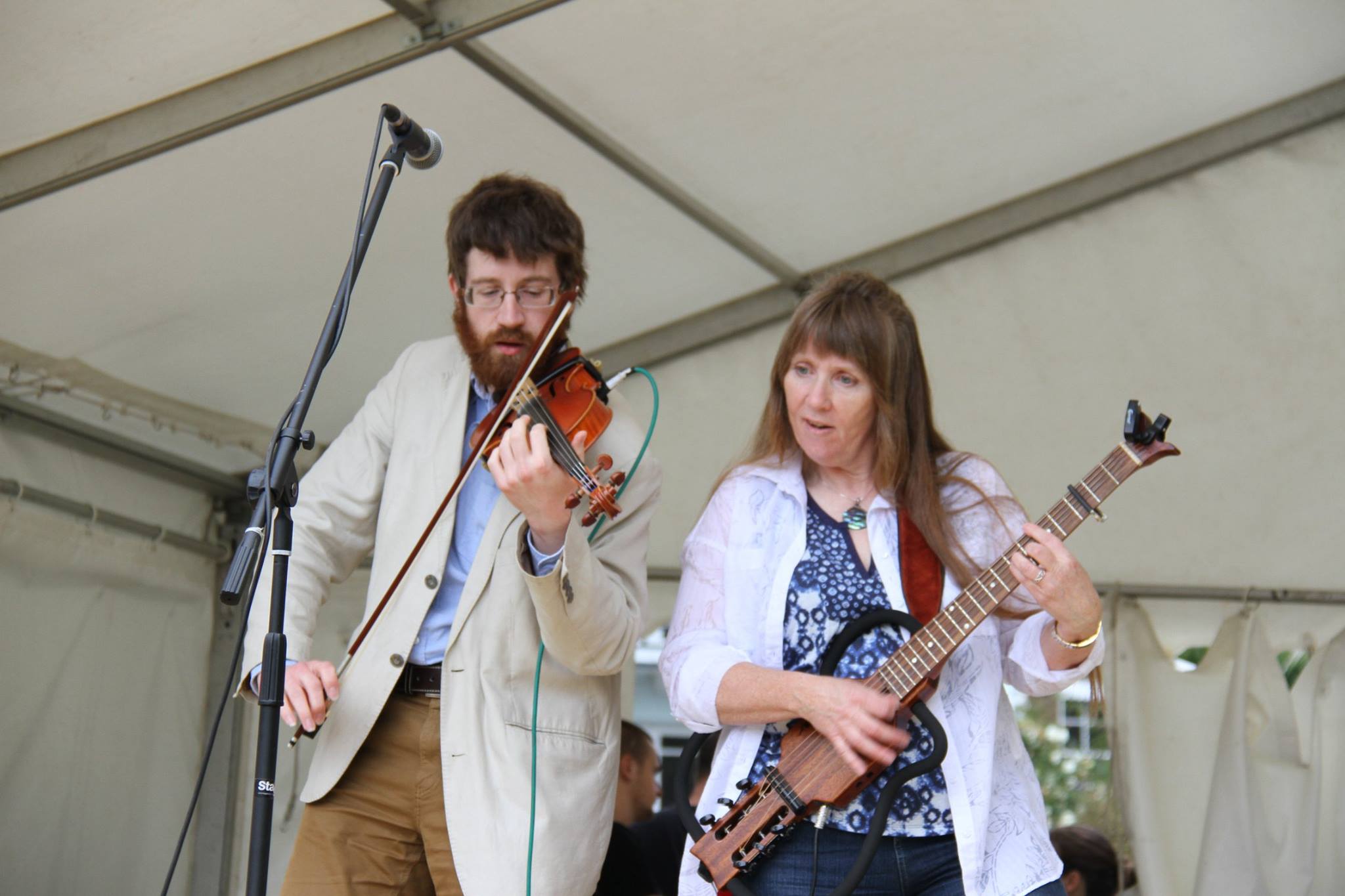
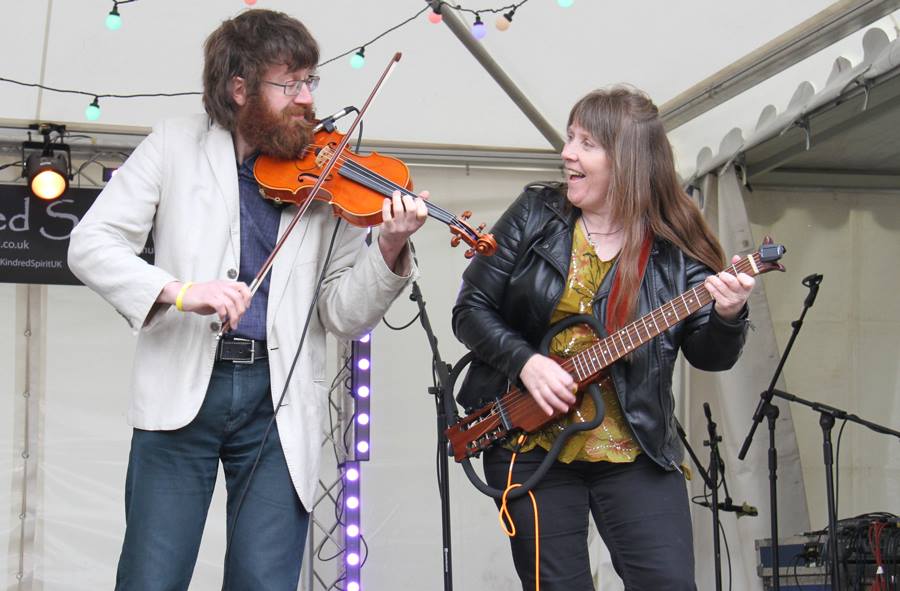
The times have been and are a-changin’ for my performance experiences at present. If you couldn’t deduce this from the above video, the Kindred Spirit Duo (ie Elaine Samuels and myself) spent most of the Easter weekend at the Tall Ships Regatta Rendez-Vous event, where we played seven sets (something like four hours’ music) at five locations in three days. Doing a nautical-themed event, we upped the folk content in preference to mainstream covers, kept a handful of Elaine’s originals in the set and, in a small new departure, incorporated some of the jigs, reels and hornpipes from my busking sets into the mix. All of this was open air (in England in April, we were very lucky to have only one set rained on and that only for about 10 minutes!), but some of it on amplified stages and some busking-style, bring your own everything. Elaine used a battery-powered busking amp for guitar and vocals; I went old-school, playing acoustic violin and singing unamplified for the busking sets and having my Fishman pickup attached to the bridge of the acoustic violin for the amped slots to avoid carrying two instruments around.

Whether in the middle of a festival site or on the street in central Woolwich, we always managed to gather a significant, if usually transient crowd, even in bad weather, and certainly everyone had a lot of fun! All in all, quite a few new or unusual things for us as a group, but hopefully not the last time for any of them.

The upcoming gigs list takes an even more unusual turn from here though. The next four items, currently covering all my non-busking live commitments until late May, are all classical, more-or-less orchestral concerts as a freelancer. ‘Business as usual’ (or is it?) with rock band gigs and myself as permanent member doesn’t resume till 27th and 28th May, when I’ll be playing with Kindred Spirit (the full band this time) and the Filthy Spectacula respectively to get the summer gig season properly under way.

Ahoy!

Normally, a greeting like that signals The Filthy Spectacula, but this time it’s Kindred Spirit (as a duo) that are getting nautical.

This weekend, Elaine and I are taking a mix of traditional songs, fiddle tunes, covers and folky originals to the Rendez-Vous Tall Ships Regatta, in Greenwich and Woolwich. With eight performance slots packed into three days, it’s going to be a busy weekend for us, but that’s really the tip of the iceberg of what’s going on around the event. With weather holding so far through this week, and it falling on a bank holiday and school holidays, there should be a real buzz round that patch of the Thames, so come on down. If you catch one of our sets, so much the better! Here’s the list:

Friday 14th:
11am, Cutty Sark Gardens stage, Greenwich
1:15pm, New Capital Quay bandstand, Greenwich

Saturday 15th:
11:15am, New Capital Quay bandstand
2pm, New Capital Quay bandstand
4:15pm, busking somewhere around and about!

Sunday 16th:
12:45pm, Powis Street stage, Woolwich Arsenal
3:30pm, Woolwich Pier stage, Woolwich Arsenal

Also cropping up in the performance listings are The Salts, who the full band shared a stage with last summer and do a really excellent line in shanties traditional and modern performed through a lens of amped-up bluegrass, and other acts from musical hall to circus, lindy hop to rockabilly, theatre to medieval dance hip-hop fusion (no I didn’t make that up!). And if you’re really bored you could always, you know, actually go and look at some sailing ships. See you down there!

Filling the gaps

Saturday’s Kindred Spirit gig, at The Acoustic Couch’s FourPlay Festival in Bracknell, went well. But it had potential to be remarkable for some of the worst reasons.

Our regular drummer, the enviably dependable and down-to-earth Alan Barwise, is still fighting off a quite serious illness, and had to confirm at the last minute he wasn’t going to be back on fighting form in time for this gig. Rather unusually for a mostly originals act, we do have signed up first reserves for some roles (the running joke is that we’re going to get one for frontwoman / songwriter Elaine … ), including drummer Aleem Saleh who is really starting to bed in having done I think three major gigs with us now. Unfortunately he was unavailable for this date in any case. Which left us doing an hour set without a drummer and with no rehearsal in that unusual four-piece configuration.

Now there are basically two ways you can take this sort of situation (assuming you’re too committed to ‘the show must go on’ to just pull the set, which I think was never in question). You can decide that losing one-fifth of the membership means losing at least one-fifth of the energy; in a sense allow circumstances to win, even if you cooperate with the inevitable by packaging it as the ‘acoustic experience’ or whatever (not that we unplugged anything).

Or, you can decide that the absence needs filling by 20% extra energy, performance and rhythm from everybody else, or at least yourself since that’s who you can be responsible for and control; stomp on the hollow stage, make extra effort to shape and direct your solo lines rhythmically, go even fiercer to the crowd in a bid to still do a rock show without the drum kit.

Knowing me in rock bands, which option do you think I went for?

It’s a real testimony to all the players involved that we pulled the set off at all I think; one reviewer describes the result as ‘a very polished and surprisingly tight performance’ under the circumstances, and I think that is a more carefully-phrased representation of feedback on the day. I received (not for the first time) the slightly uncomfortable compliment of people saying ‘I’ve bought the album, but I’m very disappointed to find there isn’t one with you on it’ – but it’s at least a consolation to know the band one man down, in a very much rock environment where absence of drums was unique in the lineup and unorthodox, can still appeal enough to sell records!

A glance at the upcoming gigs list on the home page here will reveal that this marks the end of a streak of rock band gigs, for now. The immediate future (until late May) is coloured by street performances, and then by a handful of wildly varying orchestral concerts. More on those to follow in future posts!

Away with the Spirits

Kindred Spirit are doing a string of weekend concert appearances at present, and travelling far and wide to do so. On Saturday 25 March we self-promoted a gig in a church, with support slot by the vicar’s daughter (you’d never catch The Filthy Spectacula engaged in such shenanigans). Kathryn Gleeson, the young woman in question, is one to watch in my opinion (though maybe I’m biased towards a fellow viola player) – a multi-instrumentalist singer-songwriter with a penetratingly clear but ungrating soprano register and a very nice line in flowing piano compositions.

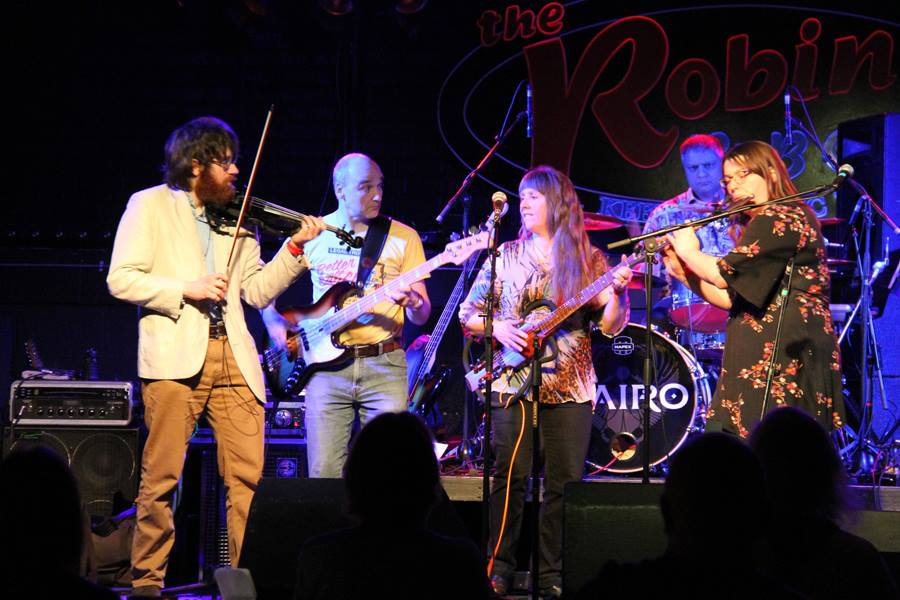
Sunday gone, 2 April, we travelled up to Bilston’s Robin 2 venue to kick off a day-long showcase for Nineteen73 Artist Promotion, who have been involved in the various magazine features and album reviews we’ve received over the last nine months or so. The turnout was good for lunchtime on a Sunday (I imagine, that far away from our territory, most of those there were taking advantage of single entry tickets to see all five bands once they’d decided to go at all); and if the low point of our set may have been an unidentified connection issue somewhere between my effects unit and the sound desk, the high point appears to have been this ‘death leap’ towards the end of our closing number:

It certainly attracted a lot of comment!

The sequence rounds off (for now) with this Saturday’s trip out to Bracknell, where we’re instrumental (and vocal) in the second annual FourPlay Festival:

http://www.sprigganmist.co.uk/fourplay.html

Also featuring three other live bands (you’d never guess would you?), in the now up and very actively running community venue theacousticcouch, slap in the heart of Bracknell (no jokes about how the heart of Bracknell is a multi-storey car park please … ). See you down the front and I’ll try not to jump on you!

(Re-)Presenting the Kindred Spirit Duo …

It won’t be a surprise to many Londoners, at least, that these are tough times for the pub trade. Continuing disposable income squeezes for most people, an ongoing awareness that we live in ‘interesting times’ in some of the worst possible senses of the word leading to an instinct to save not spend and the overwhelming attractiveness of staying in with Netflix and a bottle from Sainsbury’s make it hard to get people down their local. Add swingeing business rate rises in the capital and 2017 has not been the year of landlords having money to burn or even to incautiously invest in their business; they are more and more turning to low-overhead ways of increasing footfall, such as quiz nights and poker tournaments, and avoiding paying three-figure sums for live music.

So Elaine and I are working less in the bar gig trade with our covers and folk duo act, sadly. Some of that time and energy is going into increased activity and visibility for the full band focused on Elaine’s original material and playing bona fide music venues with door charges and aficionado audiences; some of it is going into finding the other places there is still budget to be had for engaging, performative basically acoustic live music with a fairly high proportion of ‘something what we know’ – functions, weddings, parties, Irish theme events (we do a strong line in music of the Emerald Isle).

And with that in mind, it’s about time the duo acknowledged its separate life to the originals quintet and moved out of the spare room at home, so to speak, to an online place of its own. So please head on over here for all your acoustic duo, covers and folk needs:

https://www.musicglue.com/kindredspiritduo

See you at the next fancy event …